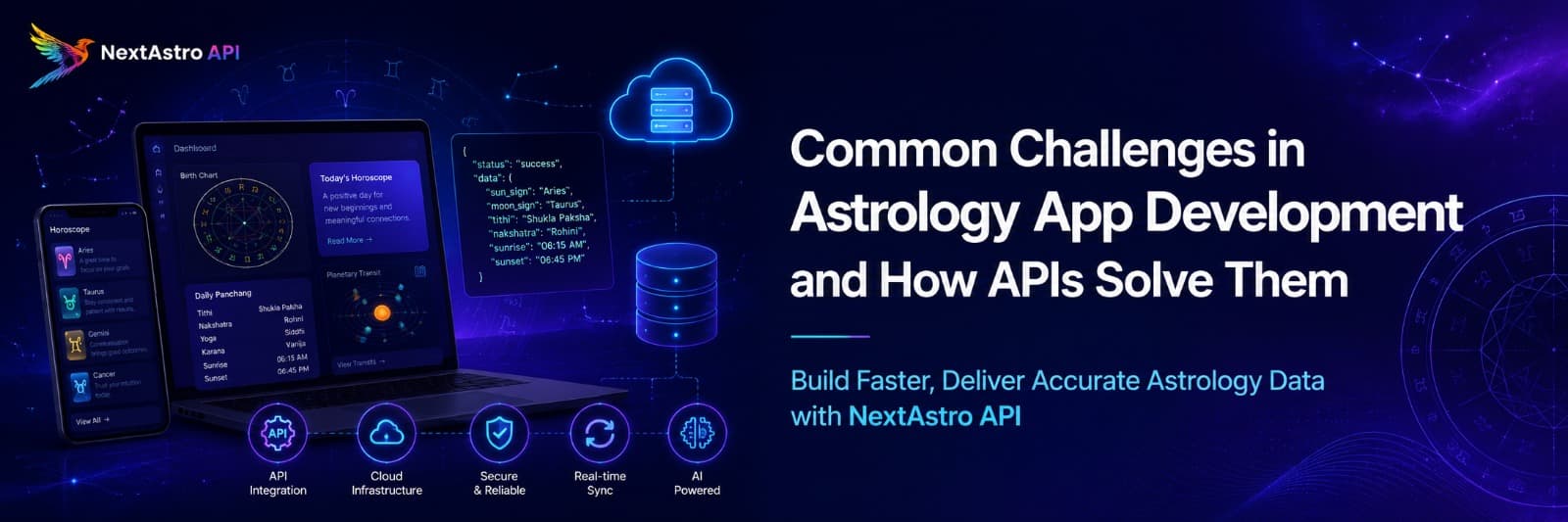
Building an astrology application involves much more than creating a beautiful interface.
Common Challenges in Astrology App Development and How APIs Solve Them
The popularity of astrology applications has grown significantly over the past few years. Millions of users now rely on mobile apps and websites to check their daily horoscope, generate birth charts, view planetary transits, read Panchang details, or perform Kundli matching. As demand continues to rise, businesses and developers are exploring opportunities to build feature-rich astrology platforms that offer accurate and real-time predictions.
However, developing an astrology application is far more complex than designing an attractive user interface. Behind every horoscope, Panchang, or birth chart lies a series of complex astronomical calculations, planetary positions, time zone conversions, and astrological rules that require precision and continuous updates.
For many development teams, building these features from scratch can be time-consuming, expensive, and difficult to maintain. This is where an Astrology API becomes a valuable solution. By integrating reliable APIs, developers can deliver accurate astrology features without spending months building complex calculation engines.
In this blog, we'll explore the most common challenges faced during astrology app development and how APIs help solve them efficiently.
Understanding Astrology App Development
Modern astrology applications offer much more than daily horoscope predictions. Users expect personalized experiences that include birth chart generation, Kundli matching, planetary transit updates, Panchang information, festival calendars, numerology reports, Vastu guidance, and much more.
Delivering all these features requires accurate astronomical data, mathematical calculations, and continuous updates based on planetary movements.
Without a reliable backend system, even small calculation errors can affect prediction accuracy and reduce user trust.
This is why many businesses now integrate dedicated astrology APIs instead of building every feature independently.
Challenge 1: Complex Astrological Calculations
One of the biggest challenges in astrology application development is calculating planetary positions accurately.
Every horoscope or birth chart depends on multiple factors, including:
-
Date of birth
-
Time of birth
-
Geographic location
-
Time zone
-
Planetary positions
-
Lunar calculations
Developing algorithms capable of performing these calculations requires extensive expertise in astronomy and Vedic astrology.
A reliable Astrology API eliminates this complexity by providing accurate calculations instantly through simple API requests. Instead of building mathematical models from scratch, developers can retrieve precise astrology data in real time.
Challenge 2: Maintaining Accurate Planetary Data
Planetary positions change continuously.
Applications providing Planetary Transit API features must update planetary movements accurately throughout the day. Even small inaccuracies may affect transit predictions and horoscope interpretations.
Maintaining this information manually requires continuous astronomical updates, testing, and validation.
Using a dedicated Planetary Transit API ensures applications always display accurate planetary movements without requiring manual maintenance.
This improves reliability while reducing development effort.
Challenge 3: Building Accurate Birth Charts
Birth chart generation is one of the most requested features in astrology applications.
Creating a birth chart requires processing numerous astrological calculations based on exact birth details.
Even minor mistakes in longitude, latitude, or time zone calculations can produce incorrect charts.
Instead of implementing these calculations manually, developers can integrate a Birth Chart API that generates detailed charts instantly while maintaining high accuracy.
This allows businesses to offer professional-grade astrology reports without investing months in backend development.
Challenge 4: Managing Daily Panchang Data
Daily Panchang information changes every day based on astronomical calculations.
Applications must accurately display:
-
Tithi
-
Nakshatra
-
Yoga
-
Karana
-
Vara
-
Muhurat
-
Rahu Kaal
-
Sunrise and Sunset timings
Calculating these values manually is extremely challenging.
A Panchang API automatically provides real-time Panchang information based on date and location, allowing developers to deliver accurate daily updates without maintaining complex calculation engines.
Challenge 5: Kundli Matching Algorithms
Marriage compatibility remains one of the most popular features in astrology platforms.
Developing a Kundli matching engine requires implementing traditional compatibility rules, Guna Milan calculations, Dosha analysis, and multiple astrological parameters.
Creating these systems independently requires deep domain expertise.
A Kundli API simplifies this process by performing compatibility calculations automatically and returning detailed matching reports through secure API endpoints.
This significantly reduces development time while ensuring consistent results.
Challenge 6: Scalability
Many astrology applications experience sudden traffic spikes during festivals, New Year celebrations, eclipses, or important planetary events.
Applications built on weak backend systems often struggle to handle thousands of simultaneous requests.
Scalable API infrastructure helps solve this problem by processing requests efficiently while maintaining fast response times.
Developers can focus on improving user experience without worrying about complex backend infrastructure.
Challenge 7: Ensuring Data Security and User Privacy
Astrology applications collect sensitive user information, including names, birth dates, birth times, and birth locations. This data is essential for generating accurate astrology reports, but it also requires proper protection.
Developers must implement secure authentication, encrypted data transmission, role-based access controls, and reliable storage practices to safeguard user information. Managing these security measures independently can increase development complexity.
A trusted Astrology API simplifies this process by offering secure API communication and reliable data handling. Instead of worrying about maintaining complex security systems for every astrology calculation, developers can focus on building a better user experience while relying on a secure backend.
Challenge 8: Keeping Features Updated
The astrology industry continues to evolve as user expectations grow. Today, users expect much more than basic horoscope predictions. Features such as Daily Panchang, Numerology, Planetary Transit updates, Festival Calendars, Birth Charts, Kundli Matching, and Vastu guidance have become standard in many astrology platforms.
Developing and maintaining each of these features separately requires significant time and technical expertise.
By integrating multiple APIs from a single provider, developers can continuously expand their applications without rebuilding the entire platform. This flexibility allows businesses to launch new features quickly and remain competitive in the market.
Challenge 9: Reducing Development Time
Building an astrology application from scratch is a lengthy process. Before launching the first version, developers often spend months researching astrology calculations, writing algorithms, testing accuracy, fixing errors, and optimizing performance.
For startups and businesses, this extended development timeline can delay product launches and increase costs.
An Astrology API significantly shortens the development cycle by providing ready-to-use endpoints for various astrology services. Instead of creating complex calculation engines, developers can integrate APIs and focus on designing intuitive interfaces, improving user engagement, and delivering a seamless customer experience.
This faster approach helps businesses launch their products sooner while reducing overall development effort.
Challenge 10: Delivering a Better User Experience
Users expect astrology applications to deliver results within seconds. Slow loading times, inaccurate reports, or confusing interfaces can quickly lead to poor reviews and reduced user retention.
Using reliable APIs helps ensure that astrology reports are generated quickly and accurately. Fast response times, consistent performance, and dependable calculations contribute to a smoother user experience.
Developers can dedicate more time to improving app design, personalization, and customer engagement rather than spending valuable resources maintaining complex backend calculations.
How APIs Simplify Astrology App Development
Instead of building every astrology feature independently, developers can integrate specialized APIs that provide reliable data in real time.
A modern astrology platform may use APIs for:
-
Horoscope generation
-
Daily Panchang information
-
Birth Chart creation
-
Kundli Matching
-
Planetary Transit updates
-
Festival Calendar data
-
Numerology reports
-
Vastu recommendations
This approach reduces development complexity while ensuring users receive accurate and consistent information across different features.
As a result, businesses can deliver comprehensive astrology platforms without investing years in backend research and development.
Choosing the Right Astrology API
Not every API offers the same level of accuracy, reliability, or scalability. Choosing the right provider is an important step in building a successful astrology application.
When evaluating an API, developers should consider several factors, including:
-
Accuracy of astrological calculations
-
Real-time data updates
-
Fast response times
-
Easy integration with websites and mobile apps
-
Comprehensive API documentation
-
Secure authentication
-
Reliable technical support
-
Scalability for growing applications
A dependable API should simplify development while maintaining high performance, even as user traffic increases.
Platforms like NextAstro API provide developers with access to a wide range of astrology services through well-documented APIs. Instead of building individual calculation engines, businesses can integrate reliable astrology features quickly and focus on creating engaging digital experiences for their users.
The Future of Astrology APIs
The demand for digital astrology services continues to grow as more businesses launch astrology websites, mobile applications, and personalized consultation platforms.
Emerging technologies such as Artificial Intelligence, machine learning, cloud computing, and predictive analytics are expected to make astrology platforms even more intelligent and interactive.
Future astrology applications will likely offer deeper personalization, multilingual support, voice assistants, AI-powered recommendations, and highly customized user experiences.
Reliable APIs will continue to play a central role in enabling these innovations while reducing development complexity for businesses around the world.
Final Thoughts
Developing a modern astrology application involves much more than creating an attractive interface. Accurate planetary calculations, Birth Charts, Daily Panchang updates, Kundli Matching, Planetary Transit tracking, security, scalability, and performance all require significant technical expertise.
Attempting to build these systems from scratch can increase development time, costs, and maintenance challenges.
By integrating a reliable Astrology API, businesses can overcome these obstacles and deliver accurate, real-time astrology services with greater efficiency. APIs simplify complex calculations, improve application performance, reduce maintenance efforts, and help developers launch feature-rich astrology platforms much faster.
Whether you're building your first astrology application or expanding an existing platform, choosing the right API can save valuable development time while ensuring a seamless experience for your users. As digital astrology continues to evolve, robust API solutions will remain the foundation for building scalable, reliable, and future-ready astrology applications.